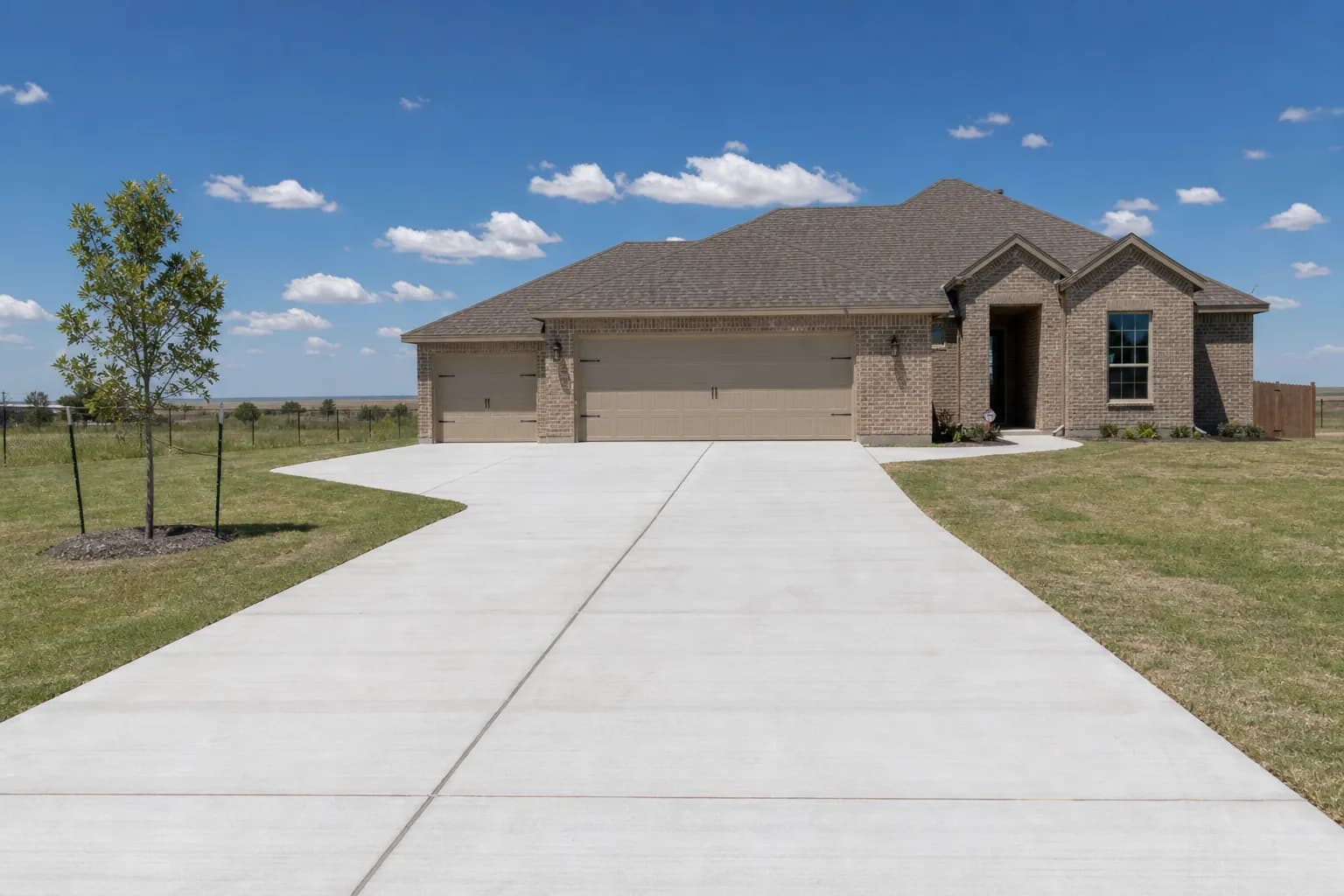
What goes into a driveway that lasts
A driveway is a slab on the ground, so the ground does most of the work. A sound job starts with cutting to grade, removing organic topsoil, compacting what is left and adding base material where the contractor calls for it. Then come forms, any reinforcing steel, the pour, finishing, joint cutting and a cure.
- Thickness. Lubbock's standard construction details set 4 inches as the minimum for driveways and sidewalks. Many owners go thicker where a loaded pickup, trailer or RV will park.
- Strength. Residential driveways are commonly specified at 3,500 to 4,000 psi. Ask what mix the contractor orders and whether it is air-entrained for freeze-thaw.
- Joints. Control joints are usually spaced at 24 to 36 times the slab thickness in inches, so roughly every 8 to 12 feet on a 4-inch slab, and cut at least a quarter of the way through.
- Finish. A broom finish across the slope gives traction on a frosty January morning. Stamped and textured finishes cost more and need sealing.
Widening and adding parking
Widening is one of the most common driveway jobs in Lubbock subdivisions, usually to add a lane for a third vehicle or a strip beside the garage for a trailer. A widening pour is tied to the existing slab with dowels or separated with an isolation joint, and the new section should match the old elevation and slope so water does not pond at the seam.
If the widening reaches the street, it changes the approach, and that part is the city's business (see below). City rules allow one driveway within the first 100 feet of frontage, with more only on very wide lots, so a second curb cut is rarely an option on a standard lot.
The approach: Lubbock permits and widths
Inside your property lines, a driveway generally needs no City of Lubbock permit unless it sits more than 30 inches above grade, covers a basement or underground structure, or the work extends past the property line. The approach between the street and your property line is public right-of-way, and the city requires a construction permit before anyone builds, repairs or replaces a driveway there.
| City rule | What it means for your driveway |
|---|---|
| Approach at least 10 ft wide at the property line | Sets the minimum for a standard residential approach |
| No more than 2 ft of sidewalk width sloped for the transition | The public walk stays mostly flat across your drive |
| 36 in minimum width at 2% or less cross slope where the walk crosses | Keeps a level path for pedestrians and wheelchairs |
| One driveway within the first 100 ft of frontage | Second curb cuts are limited on normal lots |
A secondary permit guide lists the residential flatwork permit at $75 per approach; confirm the current fee with Building Safety at 806-775-2087. Ask each contractor whether their bid includes pulling the permit and building the approach to city standard.
Caliche, clay and drainage under the drive
Most Lubbock lots sit on deep loamy soils with a caliche layer below. Near playas and draws the ground gets heavier in clay, which swells when wet and shrinks when dry. A driveway that drains toward the house or holds water along one edge gives that clay a reason to move.
Ask the contractor how they will grade the slab so water runs to the street, how they will compact the base, and what they do if they hit caliche or soft spots during excavation. Those answers matter more than the finish.
Typical driveway costs
No published source we could find lists Lubbock driveway prices. National guides put a plain 4-inch broom-finish driveway at about $6 to $12 per square foot installed, with stamped finishes at about $12 to $25 and exposed aggregate adding about $3 to $8. Tearing out an old driveway adds about $2 to $6 per square foot. A 20 by 24 foot two-car driveway is 480 square feet, so the national plain range works out to roughly $2,900 to $5,800 before removal and the approach. See the Lubbock concrete cost guide for what moves a quote.
Questions to ask before you sign
- How thick is the slab, what strength is the concrete, and is there steel?
- How will you prepare and compact the base, and what happens if you hit caliche?
- Where will the joints go and how deep will they be cut?
- Does the price include removal, haul-off, the approach and the city permit?
- How long before we can walk on it, and before we can drive on it?
- Can you show proof of general liability insurance, and are you registered with the City of Lubbock?
If the old driveway is the real problem, read driveway replacement first.
Back to the main guide: concrete contractors in Lubbock, TX.