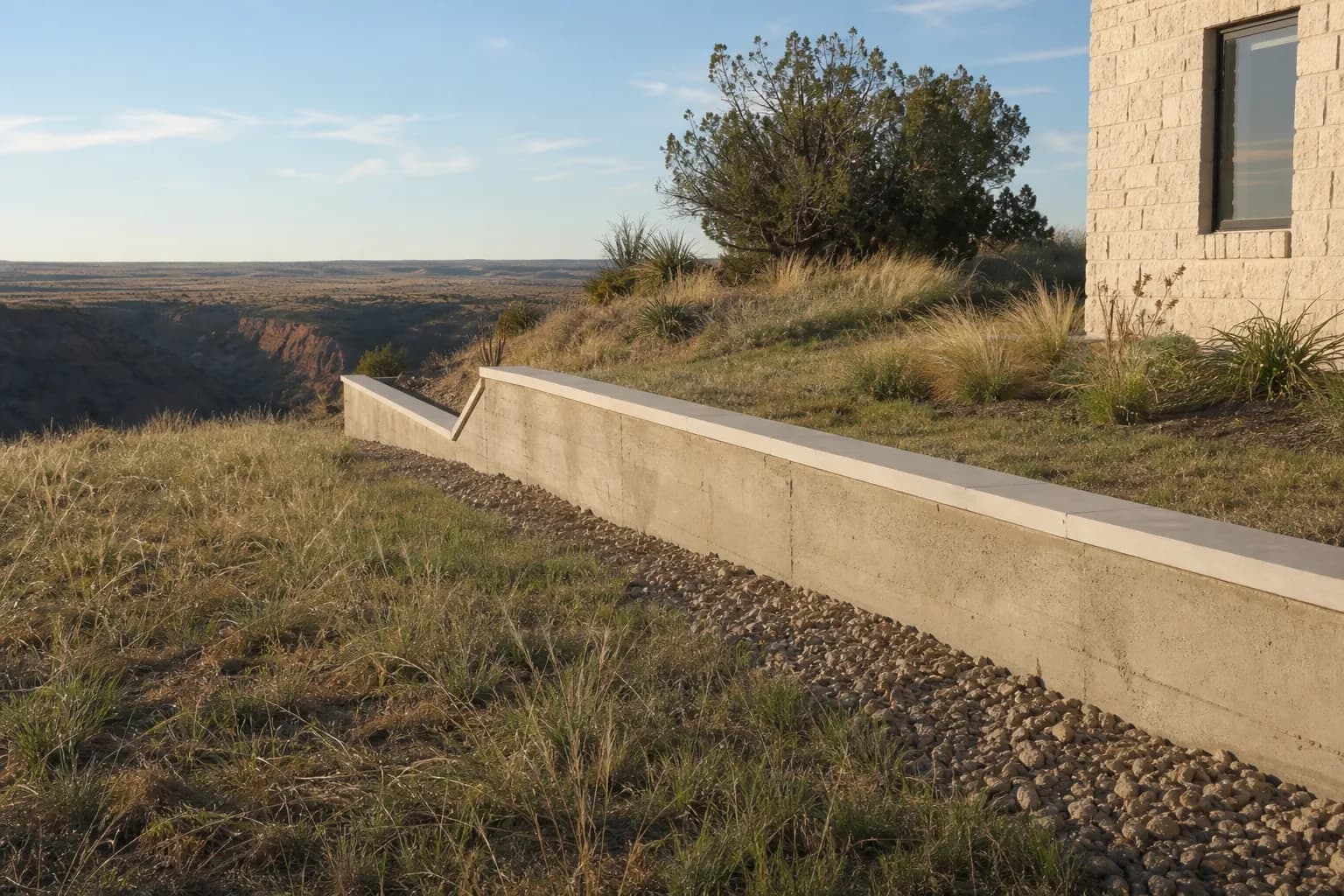
Where walls show up on the South Plains
- Canyon lots. Ransom Canyon and Buffalo Springs sit in Yellow House Canyon, where lots step down toward the lakes and walls hold driveways and yards.
- Playa edges. Lubbock's 111 playa lakes collect the city's stormwater, and yards backing onto them often slope toward the water.
- Draws. Lots along draws and the canyon run through town carry more grade than the rest of the city.
- Landscape walls. Raised beds, seat walls and terraces on otherwise flat lots.
Drainage behind the wall
A retaining wall fails from water more often than from soil. Saturated soil behind a wall weighs more and pushes harder, and clay that swells when wet adds pressure. Clean gravel backfill, a drain at the base and weep openings let water out. Where a wall faces a playa or a floodplain, also ask how high water reaches during big storms; Lubbock's mapped flood zones generally sit next to the playas and the canyon.
Height and permits
The model building codes most Texas cities adopt exempt retaining walls 4 feet or less in height, measured from the bottom of the footing to the top of the wall, unless the wall holds back a surcharge such as a driveway, a slope above or a building. Taller walls, and any wall carrying a surcharge, generally need a permit and often an engineered design. We did not confirm the City of Lubbock's adopted edition or amendments, so ask Building Safety before building near that height. In Ransom Canyon, permanent structures in an easement need city council approval and a building permit, and plans are reviewed against deed restrictions.
Poured wall or block wall
Poured concrete walls are formed, reinforced and cast in place on a footing; they suit straight runs, steps and a clean modern look. Segmental block walls stack interlocking concrete units and suit curves and DIY-scale heights. Both need the same drainage. National guides put concrete retaining walls at about $20 to $60 per square foot of wall face.
Back to the main guide: concrete contractors in Lubbock, TX.