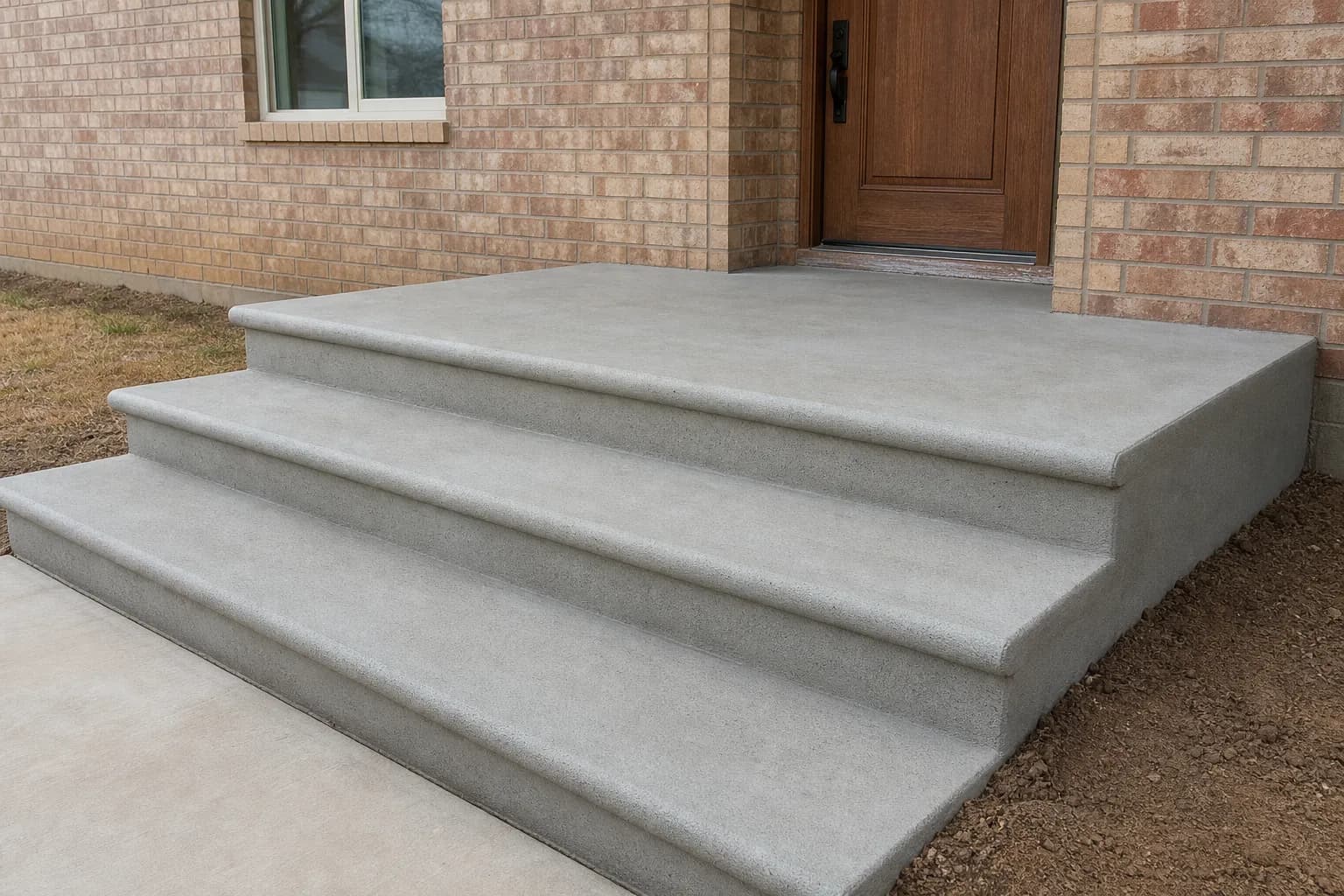
What a step job includes
Poured steps are formed in place with boards for each riser, filled with concrete and finished one tread at a time. Most sit on a footing or are tied to the porch slab so they move with it rather than separating. Larger stoops are often filled partly with compacted base to save concrete.
- Even risers. Every step in a flight should be the same height. Uneven risers are the classic cause of trips.
- Traction. A broom or light texture on each tread, plus a slight pitch so water runs off instead of freezing in place.
- Edges. A rounded nose resists chipping better than a sharp corner.
- Railing. Plan any rail post sleeves before the pour.
Freezes and old steps
Lubbock's January lows average 27.2°F, and freezes run from roughly October into April. Water that sits on a flat tread freezes and thaws over and over, which is how old steps lose their top layer and corners. A tread pitched to drain, a sealer, and avoiding salt-based de-icers on fresh concrete all help.
Old steps that have pulled away from the house, settled toward the yard or broken at the corners usually get demolished and re-poured. Steps that are only scaled on top can sometimes be resurfaced. See concrete repair and resurfacing.
Stamped and textured steps
Stamped porches and textured steps are searched in the Lubbock market alongside plain steps. They look good next to a stamped patio or walk, but sealed decorative surfaces can be slick in the wet, so ask about a grit additive in the sealer. See stamped concrete.
Questions to ask
- What will each riser height and tread depth be?
- Will the steps sit on a footing or be tied to the porch slab?
- How will the treads drain?
- Is demolition and haul-off of the old steps included?
Back to the main guide: concrete contractors in Lubbock, TX.